Climbing Mount Kinabalu in the Rain: What Changes
Rain here has a timetable, and it is not the one that ruins a summit. What a wet afternoon does to the ascent, what wet granite does to the rope sections, and what happens to a non-refundable booking when the mountain closes.
In this guide
- Rain here has a timetable
- What does an afternoon downpour do to the ascent?
- Summit night in the rain
- When does Sabah Parks close the mountain?
- What happens to a non-refundable booking if it closes?
- Wet granite, and why the rope sections change
- Does the via ferrata run in the rain?
- What to wear, in order
- Which months are wettest, and by how much?
- Is a clouded summit still worth the climb?
- Planning around the weather instead of against it
Rain here has a timetable
The single most useful thing to understand about weather on this mountain is when it arrives. Convection builds through the day, so the heavy rain lands in the afternoon — exactly when you are walking uphill to the huts. By the time you leave for the summit at half past two in the morning it has usually cleared.
That is why climbers post photographs of a flawless sunrise after describing a day of being soaked. Both are true, and they happened eight hours apart.
What does an afternoon downpour do to the ascent?
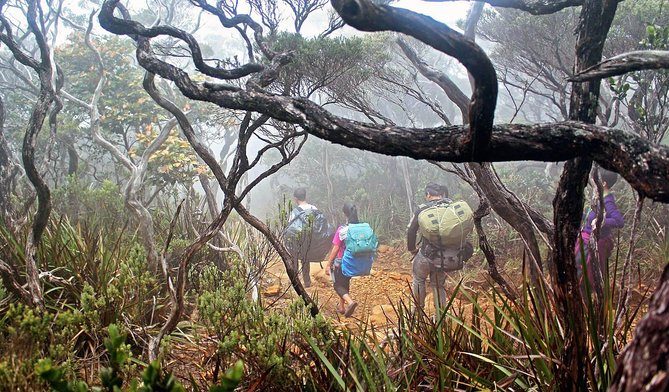
It makes day one wet, slow and slightly miserable, and it changes very little else. The trail is stone and timber steps under a canopy for most of its length, so you are rained on rather than exposed. The steps get slippery, the tree roots get worse, and everybody arrives at the huts damp.
What matters is arriving with dry clothes to change into. That is what the porter is for, and it is why the kit list asks for a complete change rather than a spare shirt.
Summit night in the rain
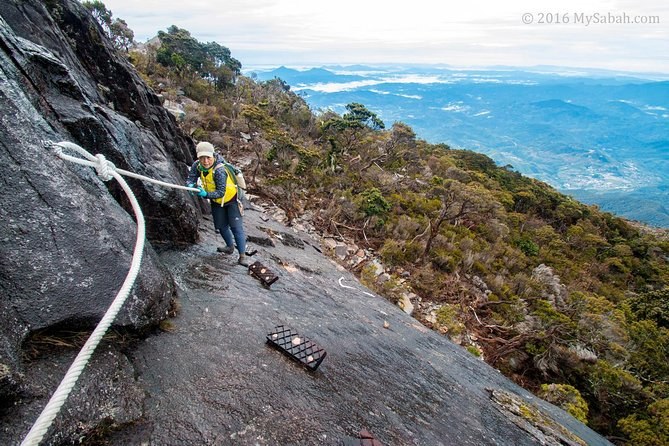
Less common than a wet afternoon, and more consequential. Rain above the checkpoint means bare granite with water running across it in the dark, which is the one part of this climb where conditions genuinely change the difficulty. The fixed rope stops being reassurance and becomes equipment.
Guides are conservative about this, and rightly. If the rock is bad you will be turned round at the checkpoint, and that decision is not negotiable.
When does Sabah Parks close the mountain?
When conditions above the huts make the summit trail unsafe — heavy rain, high wind, or lightning on the plateau. Closures are decided on the morning and apply to everybody, and they are more common in the wettest months from October to January.
A closure does not usually stop day one. What it stops is the summit push, which means you sleep at the huts and come down without having reached the top.
What happens to a non-refundable booking if it closes?
The honest answer is that it depends on the listing and you should ask before you pay. One of the climbs here states that a cancellation by the operator for bad weather gets you a different date or a full refund. The others are silent on it.
A weather closure is not the same as you cancelling, and the two are treated differently. Ask the operator directly what happens if the mountain closes on your date, and get the answer before you pay. The booking terms are worth reading in full.
Wet granite, and why the rope sections change
The summit plateau is a single sheet of glacier-polished rock. Dry, it is grippy enough that the fixed rope feels like a handrail. Wet, it is genuinely slick, and the rope is doing real work on both the way up and the way down.
Gloves with some grip are worth more here than any other single item of kit. Put your feet flat on the rock rather than on their edges, and take the descent across the slabs slower than feels necessary.
Does the via ferrata run in the rain?
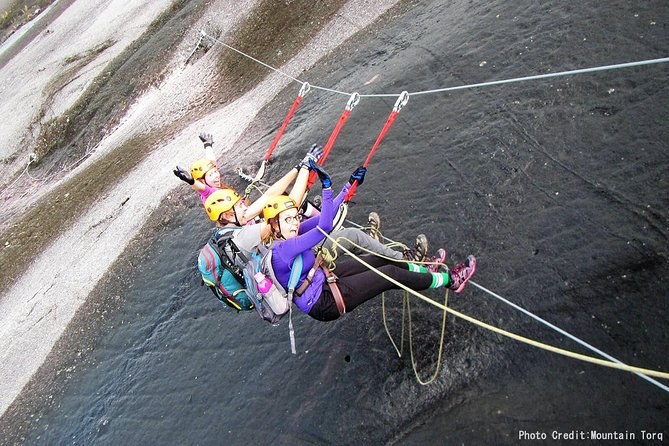
Usually, yes, unless conditions are bad enough to close the mountain. You are clipped to a steel cable throughout, so the safety margin does not change; what changes is how hard the rungs and rock are to hold. A June climber describes it as noticeably harder in the wet, and completed it anyway.
If you are weighing it up, the two routes compared covers what each asks of you.
What to wear, in order
You will change temperature bands three times in a day here, and the answer is layers you can add without stopping for long.
- Day one, low down: a light shirt. It is humid and you will be working hard.
- Day one, higher: add a windproof shell as the forest thins. The rain will arrive before you want it to.
- At the huts: the complete change of dry clothes the porter carried up. This is the item that decides how your night goes.
- Summit night: everything. Base layer, insulation, windproof and waterproof outer, gloves, hat.
- The descent: shed layers early, because you will be warm within twenty minutes of leaving the summit.
How do you get anything dry at the huts?
Mostly, you do not, and planning around that is the whole trick. There is no drying room at Panalaban and the air at that altitude is cold and damp. Anything that arrives wet will still be wet at half past one in the morning.
So the working assumption is that day one gets soaked and day two runs on a completely separate set of clothes. That is why every kit list here asks for a complete change rather than a spare shirt, and why the porter is worth the MYR 14.00 per kilogram: the dry set travels up in a dry bag rather than on your back through the afternoon rain.
Two more things that repay the effort. Line your pack, or use a dry bag inside it, because pack covers fail in the kind of rain this mountain produces. And keep one pair of dry socks completely separate from everything else, sealed, for the summit push. Cold wet feet on the granite at four in the morning is the most avoidable misery available up there.
Which months are wettest, and by how much?
October to January is the wet end of the year, driven by the northeast monsoon, and November is the wettest of them. February to April is the driest stretch and the one with the highest chance of a clear summit.
| Period | Rain | Summit clarity | Permits |
|---|---|---|---|
| February–April | Lightest of the year | Best chance of a clear sunrise | Hardest to book |
| May–September | Wet afternoons, usable mornings | Mixed; often clear at dawn | Busy in July and August |
| October–January | Heaviest; occasional closures | Cloud on the summit more often than not | Easiest to book at short notice |
The pattern by season. Rain is possible in every month; what changes is how reliably it arrives and how often the summit is clear.
See Mount Kinabalu climb availability
The month-by-month detail sits on the weather page.
What about lightning?
It is the one weather condition that reliably stops a summit push. The plateau above the checkpoint is bare rock with nothing higher on it than the climbers crossing it, and a guide will turn a group round rather than take them onto it in a storm.
Storms here are convective and build in the afternoon, which is why they far more often affect the ascent than the summit. A pre-dawn thunderstorm does happen, and when it does the decision is made at Sayat-Sayat and it is not open to discussion.
Is a clouded summit still worth the climb?
That depends what you came for, and it is worth being honest with yourself before you book. If you came for the photograph, a grey summit at 4,095 m is a disappointment and there is no way around that.
If you came for the climb, it is not. You still walked from a rainforest gate to bare granite in the dark, still stood on the highest point between the Himalayas and New Guinea, and still have the certificate. Plenty of climbers rate a wet trip five stars, and their reviews say why.
Planning around the weather instead of against it
Pick a month if you can, take the month you have if you cannot, and assume you will be rained on either way. Pack for wet on day one and cold at the top. Send dry clothes up with a porter. Ask the operator what happens if the mountain closes on your date.
Then let it go. The weather is the one part of this you cannot book around, and every climber on Mount Kinabalu Tours climbed the same mountain in the same conditions.
Frequently asked questions
Does it rain every day?
Not every day, but expect rain on most afternoons in most months. The pattern is more reliable than the amount.
Will I be turned back if it rains?
Only if conditions above the checkpoint are genuinely unsafe. A wet ascent and a clear summit push is the common outcome of a rainy trip.
Is the trail dangerous when wet?
The steps are slippery and the granite above the checkpoint is properly slick. Neither is dangerous with a guide, a fixed rope and sensible footwear, and both slow you down.
Which month should I avoid?
November, if you have the choice. It is the wettest, with cloud on the summit more often than not.
Do I get a refund if the summit trail closes?
Ask before you pay. One of the listings here promises a new date or a full refund on an operator cancellation for weather; the others do not say.
Is the via ferrata cancelled in rain?
Not usually. It runs unless the mountain closes, and the cable keeps the safety margin the same; the wet mainly makes it harder to hold.
Climbs that run through the wet season — and the rest of the planning sits on visiting Mount Kinabalu, the climb itself and the month to pick. Compare every option on Mount Kinabalu Tours.
Climbs that run through the wet season
Both run year round. One of them is the route the rain changes most.