Mount Kinabalu Via Ferrata or Summit Only: How to Choose
The world’s highest via ferrata starts where the summit trail ends, and adding it changes which hut you sleep in, what time your second day finishes and how much the climb costs. Two routes, two grades, one decision.
In this guide
- What a via ferrata actually is
- Why is Mount Kinabalu's the world's highest?
- Walk The Torq: 380 m, two to three hours, graded PD
- Low's Peak Circuit: 1.1 km, four to five hours, graded AD
- Do you climb the summit as well?
- Which hut you sleep in, and why it matters
- The briefing you cannot miss
- Can you decide once you are up there?
- Who should skip the via ferrata?
- What it adds to the price
- Which one should you book?
What a via ferrata actually is
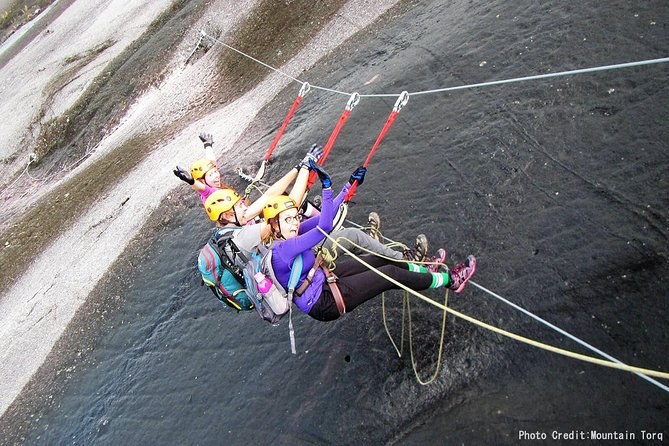
A via ferrata — Italian for iron road — is a route across a rock face built from fixed rungs, rails and steel cable. You wear a harness with two lanyards and stay clipped to that cable from the first step to the last. The exposure underneath you is entirely real; the consequence of a slip is not.
That combination is what makes it interesting for walkers. You get the position and the drop of a climbing route without needing to climb, and without a rope partner. On Mount Kinabalu it is bolted to the granite above the huts, which is why it can only be done as part of a climb rather than as a day out.
Why is Mount Kinabalu’s the world’s highest?
Because of where the granite is. Mountain Torq built the system in 2007 on the rock face above Panalaban, and the upper route reaches 3,776 m — higher than any other via ferrata on record, and certified as such by Guinness World Records.
Most via ferrata are in the Alps and the Dolomites, where the rock runs out well below four thousand metres. Kinabalu’s summit plateau is bare granite at an altitude the Alps mostly do not reach, and it happens to be reachable by a walking trail. The 2015 earthquake damaged the system and it was subsequently rebuilt.
Walk The Torq: 380 m, two to three hours, graded PD
The shorter of the two routes and the one included in a climb here. It runs about 380 m of route, takes two to three hours, tops out at 3,520 m and carries a French grade of PD — easy. Its signature features are a monkey bridge of two cable wires and a vertical ladder.
No prior climbing experience is needed. The route’s own minimum age is ten and its minimum height 1.3 m, though the listing that includes it sets a stricter band of 17 to 80. What it asks for is nerve rather than technique: you will be standing on rungs with a long drop below your feet.
Low's Peak Circuit: 1.1 km, four to five hours, graded AD
The longer route, and the one that holds the record. It runs about 1.1 km, takes four to five hours, reaches 3,776 m and is graded AD — fairly hard. It includes a suspension bridge and a Nepalese bridge of three cable wires, and it connects into Walk The Torq along the way.
The minimum age is 17. Four to five hours of via ferrata on top of a summit push that started at half past two in the morning is a genuinely long second day, and this is the route to want rather than the route to try because it was there.
Do you climb the summit as well?
Yes. The via ferrata is not an alternative to the summit; it happens afterwards, on the way down. You leave the hut at half past two, reach Low's Peak at 4,095 m before dawn as everybody does, come back to the hut, and then go out onto the iron road.
That is the single most useful thing to understand before you book. You are not choosing between the summit and the cables. You are choosing whether to add several hours to an already long second day.
Which hut you sleep in, and why it matters
Via ferrata climbers sleep at Pendant Hut rather than in the Laban Rata resthouse. That is not a comfort distinction — both are unisex shared dormitories at the same altitude, and everybody eats in the same canteen. It is a logistics one: the compulsory safety briefing happens at Pendant Hut, and you have to be in it.
Where each climb puts you is set out on the trail routes page, along with the rest of the Panalaban complex.
The briefing you cannot miss
At about half past three on the afternoon of day one, everyone doing the via ferrata attends a safety briefing at Pendant Hut. It covers the equipment, the clipping technique and the route. It is compulsory, it is not repeated, and missing it means no via ferrata the following morning.
This is the one line on the listing worth building your day around. Walk with the group rather than pushing ahead or falling behind on day one, and you will make it. How the day actually paces out is worth reading first.
Can you decide once you are up there?
No. The via ferrata is booked, briefed and equipped as part of the climb package, and the hut you sleep in follows from it. There is no arriving at Panalaban and adding it on the evening.
Which means the decision has to be made now, from the comfort of wherever you are reading this, on the basis of whether exposure appeals to you rather than on how you feel after six hours of steps.
Who should skip the via ferrata?
Anyone who does not want exposure. That is not a failing and it is not worth talking yourself out of — the route puts you on rungs above a long drop for two to three hours, and if that idea makes you tense now it will not improve at 3,500 m on no sleep.
Also worth skipping if you want the descent to be short. The standard two-day climb gets you off the mountain hours earlier, and for a lot of climbers that is the better trade the day after a 2:30am start. The standard two-day climb reaches the identical summit.
What a session actually feels like
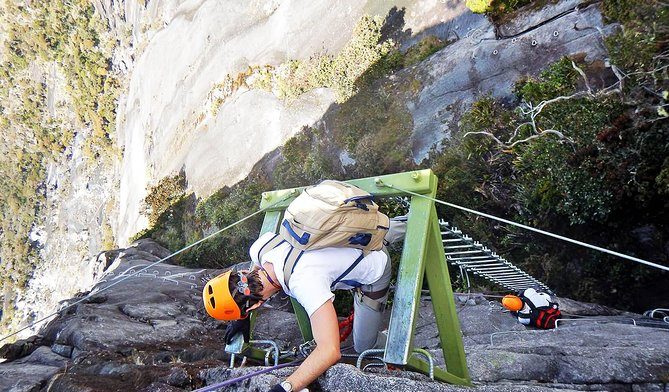
You start from the hut in a harness, walk a short way to the top of the route, and clip in. From that point on the movement is simple and repetitive: unclip one lanyard, move it past the anchor, clip it back, repeat with the other. You are never off the cable, and that rhythm is what the briefing spends most of its time on.
The rungs are steel and set into the rock at comfortable spacing. The hard part is not reaching them; it is that the ground drops away under you in a way it never does on a walking trail. Most people find the first ten minutes the worst and the rest surprisingly calm.
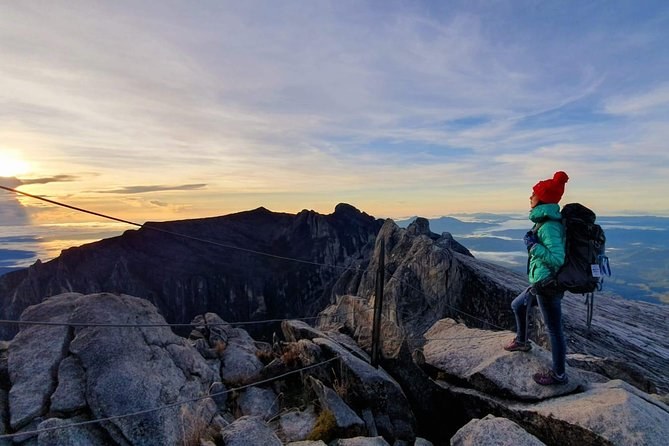
Because you are on the granite rather than on a path, the position is extraordinary. You are looking across the summit plateau and down through cloud at the forest you walked up through the day before, in daylight, having already been on the summit that morning. Climbers who do it consistently rate this above the summit push itself.
Groups are small on the cables and the guide moves with you rather than ahead. One climber describes having the guide entirely to themselves, which is common enough on the shorter route.
What it adds to the price
About a hundred dollars, on the fares captured here, and several hours of your second day. What the extra buys is the gear, the session, the guide for it and the bed at Pendant Hut — the whole thing arrives as one booking rather than as an add-on you arrange separately.
| Standard two-day climb | With Walk The Torq | |
|---|---|---|
| Fare | From $920 | From $1,020 |
| Summit | Yes | Yes |
| Via ferrata | No | Walk The Torq, 2–3 hours |
| Hut | Laban Rata resthouse | Pendant Hut |
| Compulsory briefing | No | Yes, 3:30pm on day one |
| Length of day two | Summit and descend | Summit, via ferrata, then descend |
| Rating | 4.9 from 578 reviews | 4.9 from 105 reviews |
Prices per person as captured on 1 September 2026. Both climbs are private departures from Kota Kinabalu, both are non-refundable, and both summit before dawn on day two.
Compare every Mount Kinabalu climb
Which one should you book?
Book the via ferrata climb if the idea of being clipped to a cable above a drop sounds like the best part of the trip rather than the worrying part. Climbers who do it rate it above the summit itself with striking consistency, and one describes having the guide entirely to themselves for the session.
Book the standard climb if you want the summit, the sunrise and a sensible descent, or if you are unsure. The mountain is the same either way. Compare both against every other climb here, or read what the fare covers before you decide.
Frequently asked questions
Is the via ferrata harder than the climb itself?
Physically, no. It is short and you are clipped in throughout. Mentally it depends entirely on how you feel about exposure, and that is the honest test to apply before booking.
Do I need my own equipment?
No. The harness, lanyards and helmet come with the session, and the fare covers them. Bring gloves that grip, because the cable is steel and the rock is often wet.
What happens if the weather is bad?
Sabah Parks and the operator decide, and wet granite changes the route more than rain changes the walk. A June climber found it noticeably harder in the wet and still completed it.
Can children do Walk The Torq?
The route’s own minimum is age ten and a height of 1.3 m. The listing that includes it sets 17 to 80, which is the band that binds when you book.
How long is day two with the via ferrata?
Long. Up at half past one, summit before dawn, back to the hut, then two to three hours on the cables before the descent proper begins.
Is the Low's Peak Circuit bookable here?
Not on the climbs listed here. Walk The Torq is the route included; the Circuit is run by the same operator on the mountain and is worth asking about directly if it is the one you want.
Climbs with and without the iron road — and the rest of the planning sits on visiting Mount Kinabalu, the climb itself and the month to pick. Compare every option on Mount Kinabalu Tours.
Climbs with and without the iron road
The same summit, the same trail, and one decision between them.