2 Days or 3 Days on Mount Kinabalu: Which Climb Is Worth It?
The short answer
Book the three-day climb if you are nervous about the altitude, travelling alone, or able to spare the leave. Book the two-day if your schedule is tight or the extra $280 buys something better elsewhere in your trip. Both reach exactly the same summit at 4,095 m by exactly the same trail.
What is genuinely different
| Two days, one night | Three days, two nights | |
|---|---|---|
| Fare | From $920 per person | From $1,200 per person |
| Nights | One, on the mountain | Two |
| Start time, day one | 6:00am pickup in Kota Kinabalu | 10:00am from Kinabalu Park |
| Starts from | Your Kota Kinabalu hotel | Kinabalu Park, Kundasang |
| Group | Private — only your own party | Shared, capped at ten |
| Minimum booking | Two travellers | One traveller |
| Age band on the listing | 17 to 80 | 18 to 50 |
| Cancellation | Non-refundable | Non-refundable |
Figures from the two listings as captured on 1 September 2026. The summit, the trail and the huts are identical.
The real tension: a 6am pickup against $280
Here is what the comparison turns on. On the two-day climb you are collected at six in the morning. You are driven two hours inland and up, registered, and walking by mid-morning. By then you have been awake four hours. That evening you eat at half past four and try to sleep at 3,272 m. Sixteen hours later you are on the summit.
On the three-day you arrive the day before, sleep at the park, and start walking at ten with a night behind you. Everything after that is the same. You are paying $280 and one day of leave for a night’s sleep and a slower start.
If you have flown into Kota Kinabalu within a day or two of the climb, the extra night is worth more than it looks. Jet lag plus a 6am pickup plus 2,200 m of ascent is a lot to ask of a first day.
The case for two days
It is the cheaper fare and it takes a day less out of a trip. It is also private: only your own group on the mountain, at your own pace. And it carries far more reviews than anything else here, which is worth something when you are choosing between operators you have never met. Fit, travelling as a pair, and used to early starts? Book this one.
The case for three days
It is the only format here that books at a single traveller. That matters if you are climbing alone: the private climbs take a minimum of two, so a solo climber pays twice. It caps the group at ten. And it gives you a night before the ascent, which is the most useful thing you can buy here.
The trade-offs are real: a shared departure rather than a private one, an 18-to-50 age band that the private climbs do not impose, and an MYR 500 supplement if you book as one person.
What neither of them changes
- The summit. Same peak, same trail, same checkpoint.
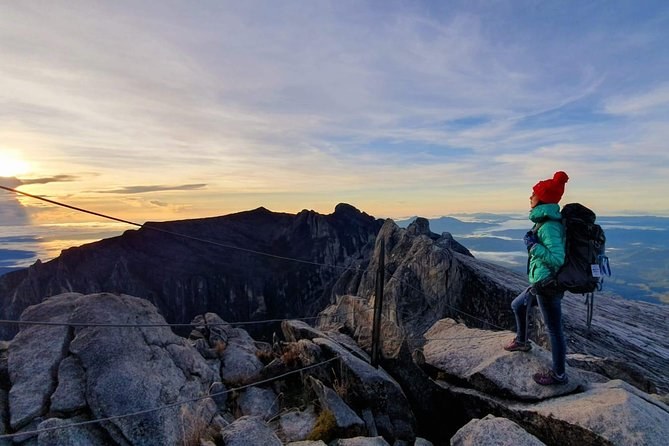
- The 2:30am start. Every guided climb summits before dawn.
- The compulsory guide, and the permit cap behind it.
- Non-refundable terms, on both, following Sabah Parks.
- The four charges settled on the mountain — porters, guide overtime, transport overtime, outskirt pickup.
What the fare difference is not buying
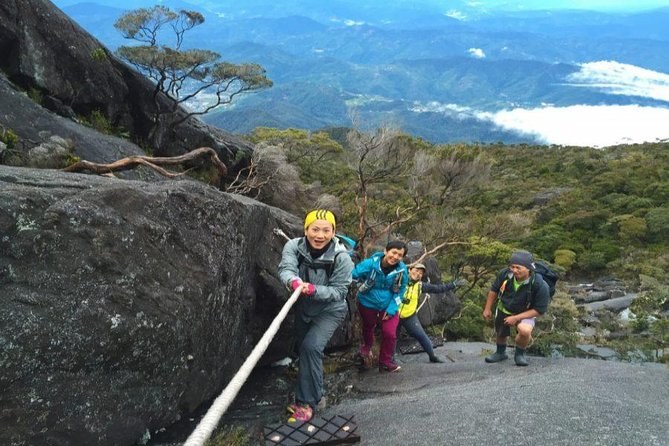
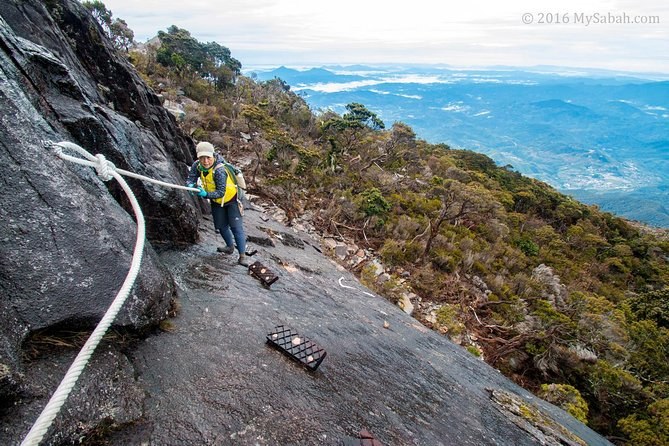
It is worth being clear about what $280 does not get you. It does not buy a different summit, a shorter walk, a better hut or a lighter pack. It does not make the 2:30am start any later. It does not remove the fixed rope, the cold, or the descent afterwards. Both formats put you on the same granite at the same hour of the same morning.
Can you do both? No — but there is a third option
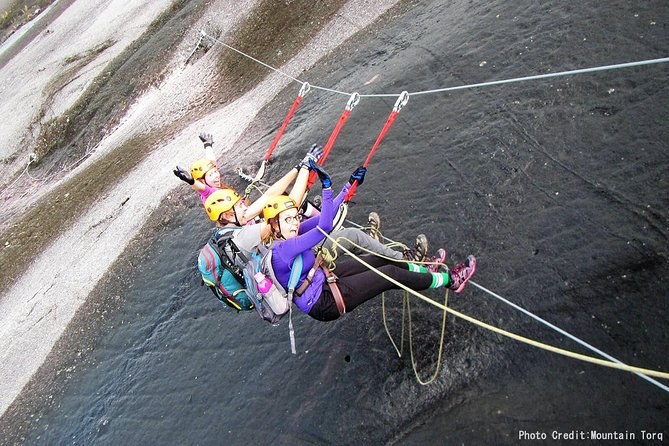
The formats are alternatives rather than a sequence. What you can add, on a two-day climb, is the via ferrata: Walk The Torq, the beginner route on the world’s highest iron road at 3,520 m, done on the descent after the summit. It costs $100 more than the standard two-day and makes the second day several hours longer. For climbers who want the mountain to be more than a walk, it is the most interesting thing on offer here.
What the extra night does to altitude, in practice
Park Headquarters sits at about 1,563 m and the huts at 3,272 m. Sleeping a night at the lower altitude before you walk will not acclimatise you in any physiological sense — that takes days at height, not one night at fifteen hundred metres. What it does is subtler and still worth paying for: you start the ascent rested, hydrated and unhurried rather than four hours into a day that began in the dark on the coast.
Most of what climbers describe as altitude trouble on this mountain is a compound of thin air, a short night and a long day, and only one of those three is fixed. The three-day format removes the other two. If you have had a headache above three thousand metres before, that is the version to book; if you have not, the two-day is a reasonable bet at $280 less.
Verdict by climber
| If you are… | Book |
|---|---|
| A fit pair on a tight schedule | The two-day private climb |
| Travelling alone | The three-day — it takes one traveller |
| Worried about the altitude | The three-day, for the extra night |
| Arriving in Sabah the day before | The three-day |
| After more than a walk-up | The two-day with Walk The Torq |
| Counting every dollar | The two-day private climb |
All three formats summit Low's Peak before dawn. The difference is what happens either side of it.
Whichever you pick, pick the date first. Permits are capped at about 130 a day and none of these fares is refundable. How far ahead to book is the one page to read before you pay.
Still undecided? The full comparison of every format sits on Mount Kinabalu Tours, and the climbing page covers what the mountain asks of you regardless of which one you book.
Whichever way you lean, lock the date before anything else moves. Permits, fares and booking windows, the trail by altitude and the month to pick are each a click away — or compare every climb on Mount Kinabalu Tours.
Every format, side by side
All four guided climbs, so you can see the two-day, the three-day and the via ferrata against each other.