Mount Kinabalu for First-Time Climbers: Can You Do It?
Can an ordinary person actually do this?
Yes, and most do. Mount Kinabalu takes no ropework, no crampons and no previous mountain experience. What it takes is the willingness to walk uphill for six to eight hours, sleep badly, and then get up at half past one and do three more hours in the dark. The barrier is stamina and stubbornness rather than skill.
The listings ask for a moderate to strong fitness level. In practice, if you can do a long hill walk with a day pack and get out of bed the next morning without regret, you will finish. If a flight of stairs is a negotiation, start walking hills now and book for four months out.
The three things first-timers get wrong
- They book flights first. Permits are capped at about 130 a day and go months ahead. The date is the scarce thing.
- They pack for Borneo. It is genuinely cold above 3,000 m before dawn, and gloves are not optional.
- They plan the day after. The descent takes more out of you than the summit does, and stairs become a problem for two days.
What the first day actually feels like
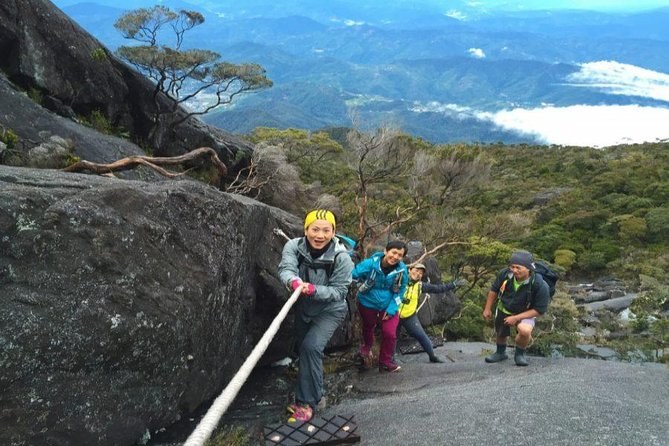
Long, humid at the bottom, cold at the top, and relentlessly upward. The Timpohon Trail is essentially a staircase of stone and timber steps with tree roots between them, and there is very little flat ground on it. Most groups take six to eight hours to cover six kilometres, which tells you everything about the gradient.
Your guide sets the pace to the slowest person in the group, and that is a feature rather than a compromise. Going slowly on day one is what leaves you with something for day two.
The night at the huts
You arrive at Panalaban, 3,272 m up, some time in the afternoon. Dinner is served from half past four. Lights go out at eight and you will be woken at half past one. Almost nobody sleeps well: it is cold, it is a shared dormitory, and the altitude gives most people a headache.
Eat dinner even without an appetite, drink more water than you want, and lay out every layer before you get into your sleeping bag. At half past one in the dark you will not want to be looking for a glove.
Summit night, which is the whole point
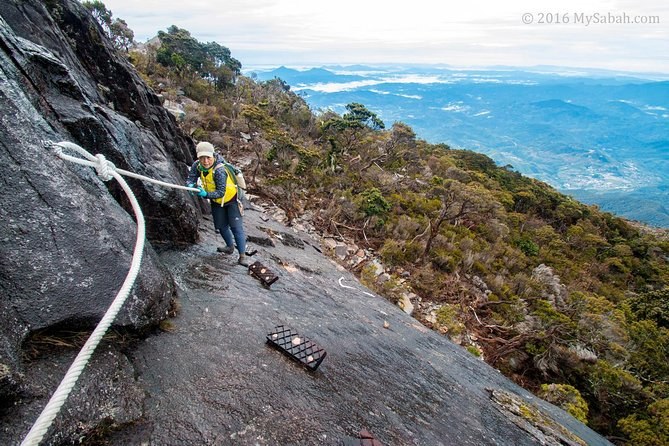
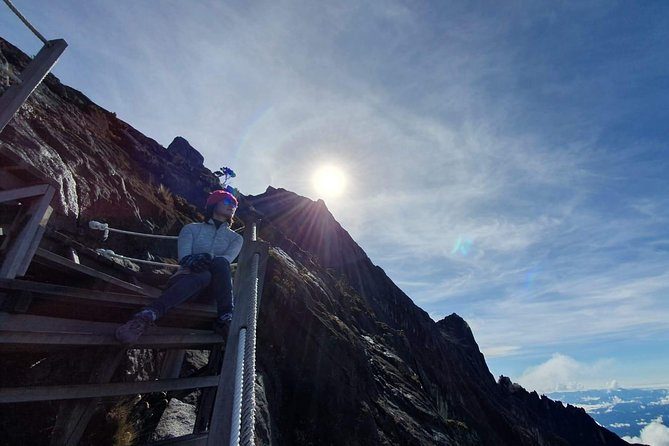
Half past two in the morning, head torch on, into a staircase. An hour of steep steps to the checkpoint at 3,668 m, where everybody signs in. Then open granite with a fixed rope, a gentle angle, and head torches strung out above and below you in the dark. It is cold, it is quiet, and it is the bit people remember for years.
You reach 4,095 m before the sun does, get about twenty minutes at the top, and start down. If the cloud is kind you see Sabah laid out under a sea of it. If it is not, you still stood on the highest point between the Himalayas and New Guinea.
Which format suits a first-timer
| Format | What it gives a first-timer | What it costs |
|---|---|---|
| Two days, one night | The lowest fare, and the fewest days off work | You start walking after a 6am pickup and a two-hour drive |
| Three days, two nights | A night to arrive on, and a group capped at ten | $280 more and one more day of leave |
| Two days plus the via ferrata | A second day that is genuinely memorable | A much longer second day, on top of a 2:30am start |
For a nervous first-timer the three-day format is the one that buys the most reassurance per dollar.
If you are unsure about the altitude rather than the walking, the extra night is the cheapest insurance available. If your leave is tight, the two-day climb reaches exactly the same summit.
What to eat and drink, and when
Eat more than you want and drink far more than you want. Altitude blunts appetite exactly when you need calories most, and the classic first-timer mistake is skipping the hut dinner because you feel slightly sick and then leaving at half past two with nothing in you.
Carry chocolate, nuts, raisins or glucose sweets and eat something small every hour rather than a meal every four. Fill your bottle at every shelter on the way up. Above the huts there is no water at all until you are back down, and the summit push is the driest three hours of the trip.
What if you do not make it?
Then you do not, and it is a normal outcome rather than a failure. A guide will turn a group round above the checkpoint if the weather or the pace makes continuing unwise, and that decision is not negotiable. The certificate records how far you got. The mountain does not move.
What you cannot do is get your money back. Every climb here is non-refundable, following Sabah Parks’ own reservation terms, so the decision that matters is the date you pick. Read the booking terms before you pay.
What the descent does to you
Nobody warns first-timers about the way down, and it is the part that hurts. You come down the same 8.5 km of steps you climbed, having been awake since half past one, on legs that have already done a summit push. It takes most groups four to six hours from the summit back to the gate.
Two things help more than anything else. Walking poles, if you use them, take a real share of the load off your knees on a descent that is almost entirely stepped. And a second pair of shoes waiting at the hut — on the kit list for exactly this reason — means you are not descending in boots that have been wet since yesterday afternoon.
Expect two days of stairs being a negotiation afterwards. That is normal, it passes, and it is the argument for putting a hot spring rather than a flight in the day after the climb.
Getting ready, four months out
- Book the permit date first. Everything else moves.
- Walk hills with a loaded pack, weekly, building to a full day.
- Break in your shoes. New boots and 8.5 km of steps do not mix.
- Practise a long descent. It is the part nobody trains for and everybody feels.
- Buy a head torch, and use it once before the mountain.
That is genuinely all of it. Compare the Mount Kinabalu ticket prices on format rather than on price, read what the climb asks of you, and pick a date you can commit to.
Nervous is normal, and it is not what stops people finishing. Permits, fares and booking windows, the trail by altitude and the month to pick are each a click away — or compare every climb on Mount Kinabalu Tours.
The two gentlest ways up
Both cap the group and both give you more room to acclimatise than a private dawn pickup does.